Reuter West Combined Heat and Power Plant, Spandau
BEW Berliner Energie und Wärme GmbH
Gruber + Popp Architects, BDA
Jil Velden, Elias Schau, Parzival Schneider, Pia Drewes
4,650 square meters
2023–2025
The Reuter West power plant in Berlin's Siemensstadt district is being modernized:
The former coal-fired facilities are being converted into a modern, low-carbon power plant complex.
Due to these extensive measures, the existing cafeteria, offices, and staff building had to be replaced: They were rebuilt in an attractive and forward-looking design. In this context, a competition was announced in October 2023 with five participating architectural firms, which Gruber + Popp Architekt:innen BDA won.
The client sought a design that would exceed the minimum requirements of the Building Energy Act and support sustainability standards (ESG—Environmental, Social, and Governance). The tight timeline posed a particular challenge: the buildings were to be ready for occupancy as early as fall 2025.
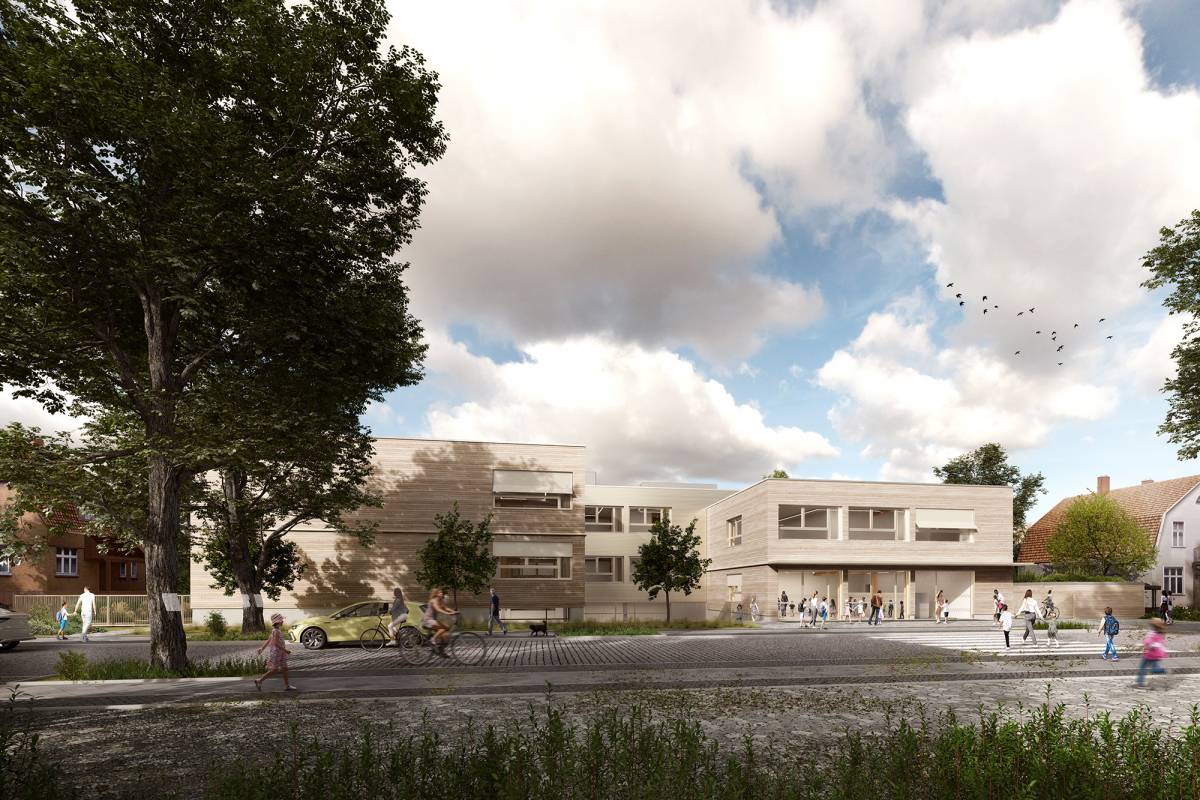
The design by Gruber + Popp Architects calls for three modular buildings with wooden facades: a complex comprising a cafeteria, restrooms, and office buildings will be situated in the southeastern part of the property, amidst the industrial surroundings. This not only creates proximity to the water but also provides ample space for a new garden—working in a green setting.
The cafeteria is designed as a single-story building located on the southern part of the property, overlooking the harbor. A glass facade that can be fully opened, a terrace in front of the dining hall covered with movable elements, and another terrace directly on the water ensure a very high quality of comfort and relaxation.
The three-story office building creates a pleasant and highly functional work environment. Since the chosen design does not rely on load-bearing walls and is therefore maximally flexible, all variations of office workspace design—from private offices to open-plan offices—are possible. A key focus is on promoting internal communication—the hallway on every floor is designed as a “communication corridor.” The restroom building houses the showers and changing rooms for both internal and external BEW employees.
All roofs are designed as retention roofs with green roofs and rainwater management systems; climbing plants grow on the exterior stairwells. The office building will be equipped with a photovoltaic system.
In addition to the resource-efficient construction methods used here and the emphasis on a circular economy, the buildings’ flexibility of use is a key feature of sustainable construction. Since the design allows for many different floor plans and thus various uses, the buildings—and all the raw materials and resources used in their construction—can be preserved for a very long time. The new campus meets the sustainability requirements of the DGNB Gold Standard building certification.
Once the property has been opened up as much as possible, a staff garden will be created. The garden has a positive impact on nature and people in several ways: trees absorb CO2, produce oxygen, cool the area, and provide shade. Extensive meadows with flower strips serve as a habitat and food source for insects and create an attractive landscape.